

The Challenge: Turning an Ambitious Vision Into a Real, Buildable Product
A founder approached me with a broad ambition: create an AI-powered system that could help high school basketball coaches prepare for games, make better decisions, and support their teams more effectively.
The idea was promising but unstructured. There were no workflows, no defined inputs, no clarity around model capabilities, and no understanding of what coaches actually needed.
The real challenge was bridging vision and reality. The product needed to deliver meaningful value fast, while respecting the constraints of high school coaching: limited tools, no telemetry, inconsistent data, and heavy manual workflows. The goal was to define a system that was grounded in behaviour rather than assumptions.
My Role: Product Strategist, UX Architect, and Early Execution Partner
I was brought in at the idea stage to give shape to the vision and guide the product through its earliest and most uncertain phase. My role covered:
- Product strategy
- Behavioural research
- Story mapping
- Rapid prototyping
- Early architecture decisions
- MVP direction
- Interface design
- Brand narrative
- Early marketing materials
I helped the founder turn a raw idea into a structured product with a clear direction, a validated foundation, and a credible path forward.
Exploring the Possibility Space
The first step was understanding what the product could become. The founder had dozens of ideas but no structure behind them. I ran a series of story mapping sessions to expose the full surface area of the opportunity and create a coherent framework for discussion.
What this phase uncovered:
- All potential pre-game features
- Opportunities for in-game decision support
- Post-game analysis and long-term learning loops
- Future ideas around simulation, training tools, and automated video intelligence
- Dependencies and the natural order in which features should appear
- Early clarity on where the product could create real leverage
This process turned scattered thoughts into a structured opportunity map the founder could understand and prioritise.
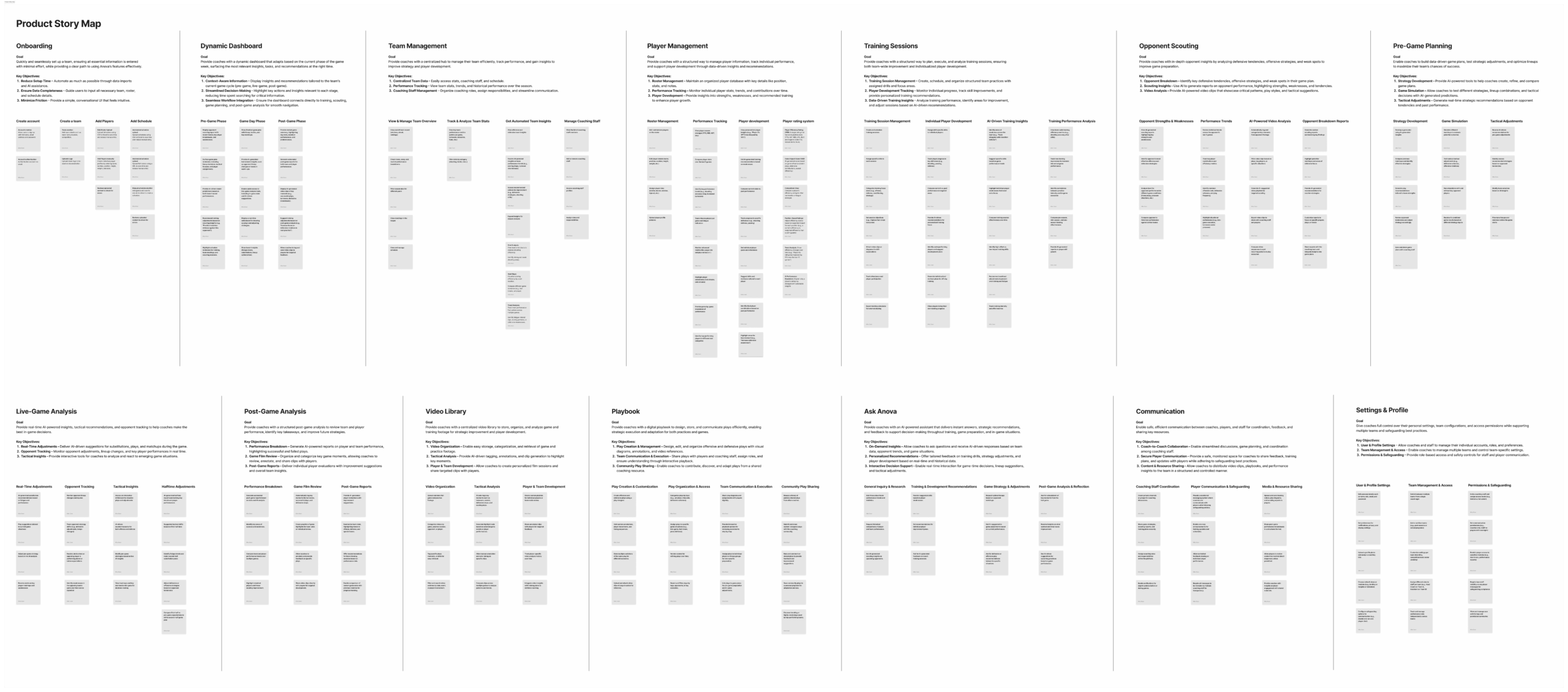
Product Story Map: Mapping the full surface area of the opportunity (Detail redacted).
Understanding Real Coaching Behaviour
To ground the product in reality, I immersed myself in how high school coaches actually prepare and make decisions. What we found reframed the entire product direction.
Key findings:
- Coaches use a fragmented mix of tools, spreadsheets, PDFs, video tools, notebooks, and group messages.
- None of these tools connect, creating inconsistency and repetitive work.
- A single game plan takes around three hours. Over a full season that becomes roughly ninety hours of admin work.
- In-game decisions rely on observation only. There are no live data feeds or telemetry at this level.
- Coaches want better preparation, clearer insights, and confidence under pressure.
- Their identity matters. Tools must make them feel more prepared and more effective, not automated or replaced.
This shaped the job to be done: reduce manual work, improve decision quality, and support the full game cycle.
Validating Assumptions With a Scrappy Prototype
Before design or engineering, I built a fast Make.com prototype to test how different models reacted to real coaching inputs. The goal was clarity, not polish. We needed to understand the strengths and limitations of AI before committing to a build.
What the prototype revealed:
- Models handled narrative, tendencies, and structured text well.
- They struggled with raw stat tables, multi-step calculations, simulations, and inconsistent number formats.
- Long reasoning chains often broke down.
- Early video analysis was unreliable and inconsistent.
- Insights were strong only when the underlying data was structured cleanly.
This early work prevented months of wasted engineering time by exposing where AI created value and where it failed.
Resulting decisions:
- Do not rely on a single model.
- Build a layered system combining deterministic logic, simulations, and LLMs.
- Keep the early focus on tasks that deliver value immediately.

The Make.com prototype allowed us to test prompts, data structures, and model behaviours before committing to engineering.
High-level view of the logic architecture (Obfuscated for client confidentiality).
Sequencing the Work and Deferring High-Cost Features
We explored the potential for automated video analysis, but it became clear that accurate video understanding would require a specialised model, detailed tagging, possession-level context, and a large training dataset. This was a separate product in itself.
I made a deliberate decision to defer video analysis to a later phase. Coaches did not need perfect video automation to get value today. They needed clarity, pattern recognition, and support across the pre-game and in-game cycle.
Building the MVP Plus
Once the strategy and validation work was clear, I helped bring in an AI engineer and guided the build of the real MVP. This phase was about turning the validated logic into a reliable foundation.
My contribution:
- Translating product strategy into technical requirements
- Defining the early architecture
- Structuring and cleaning data inputs
- Designing the core loop
- Writing stable, structured prompts for predictable outputs
- Ensuring accuracy and clarity before introducing UI
The MVP Plus reflected only the essential core value. It was designed to be stable, expandable, and trustworthy.
Designing the Interface Last, Not First
Only once the system itself was validated did I begin designing the interface. The design avoided dashboards, visual clutter, and complexity. Coaches need clarity, not more noise.
The UI focused on:
- Reducing cognitive load
- Simplifying inputs
- Presenting insights in a clear, readable way
- Guiding coaches rather than overwhelming them
- Supporting real workflows instead of idealised ones
- Creating a design system that was very easy to build utilising reusable components
The interface became a thin layer over a system that had already been proven.
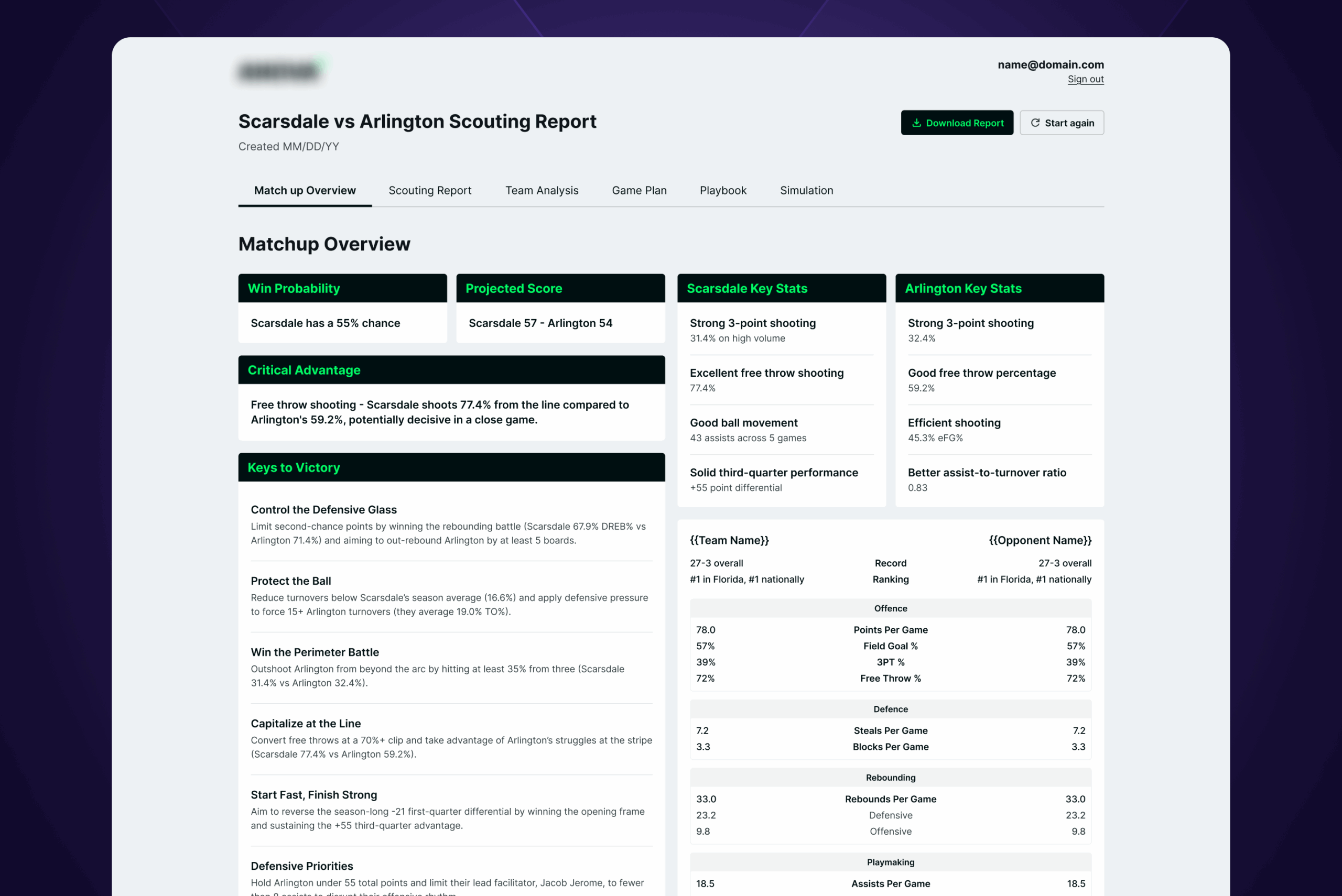
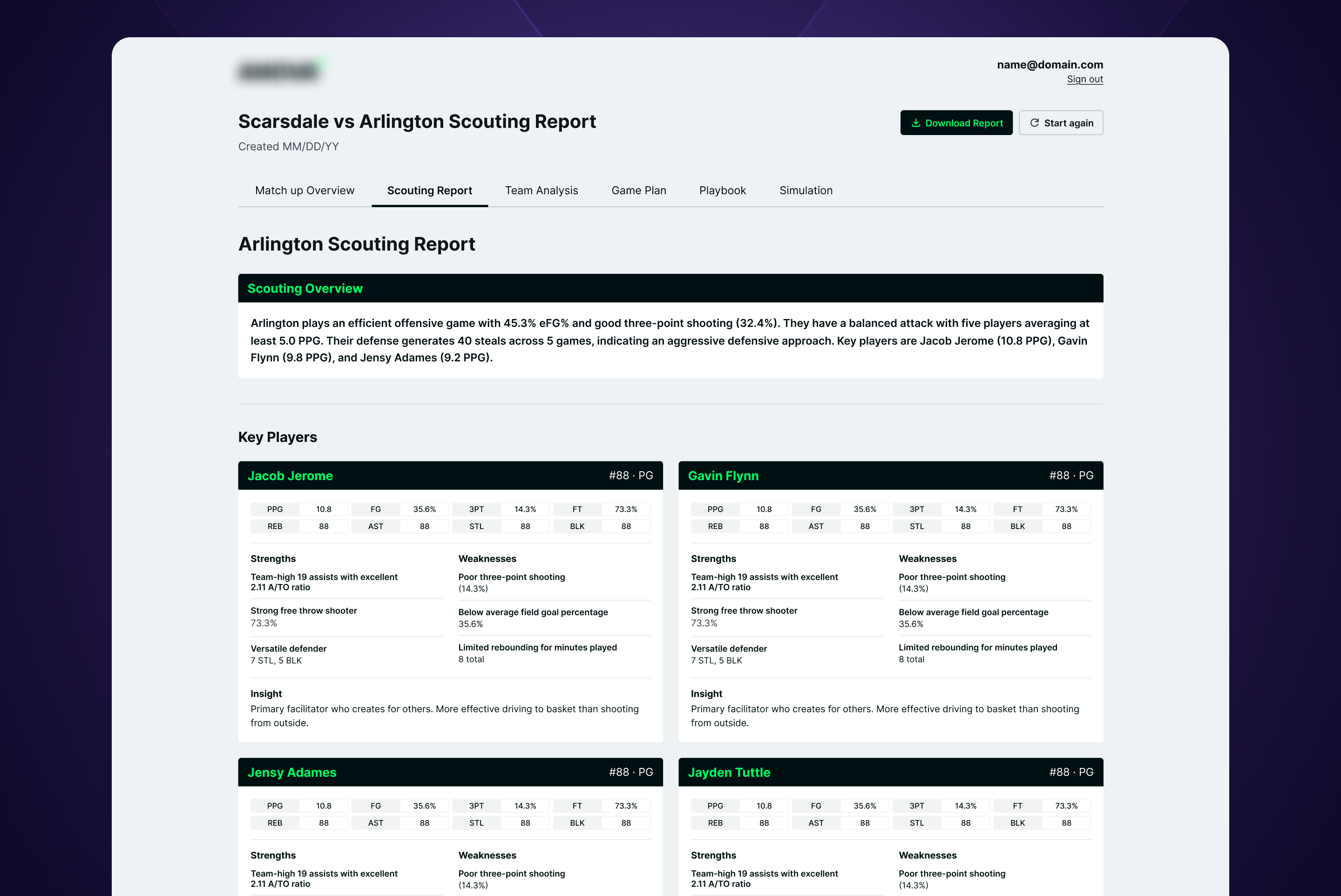
The interface was kept deliberately simple due to engineering resources and the desire to move fast. Focusing on content rather than the interface was the primary objective.
Creating the Brand and Early Marketing Materials
To support early traction and stakeholder conversations, I shaped the brand narrative and produced the first marketing assets.
This included:
- An initial brand direction
- Messaging pillars
- A product and partnership deck
- The landing page
- Early outreach materials
The positioning framed the product as a partner that helps coaches make better decisions, not as an AI gadget or shortcut. This resonated strongly with early testers.
The Outcome
By the time the MVP was ready, the product direction had a solid foundation. It was grounded in real coaching behaviour, validated workflows, and a clear understanding of where AI created reliable leverage. We avoided building a generic tool and instead created the base of a system that supports coaches before games, during games, and after games.
The work moved the concept from an unstructured idea to a structured, credible product with a defined strategy, a stable architecture, a predictable workflow, and a coherent narrative.
The result was a clear, dependable foundation that could scale into a full coaching intelligence platform over time.
Why This Matters
This is the type of work I do at SGX. I take early ideas and turn them into structured products with clear direction. I focus on behaviour, clarity, and sequencing. I validate assumptions with fast experiments rather than letting teams drift into costly builds. I help founders create systems that meaningfully support the way people actually work.
For this project, it meant giving coaches a clearer way to prepare, think, and make decisions, and giving the founder a product with real direction rather than speculation.
Professional note: This case study showcases the foundational design architecture and conceptual UX/UI work I delivered. The final execution and continued iteration are handled by the client’s internal team.
Sports Product Strategy & UX Design Case Studies
Clear, outcome-focused case studies showing how I’ve helped sports brands simplify complexity, sharpen their product direction and design experiences that keep users returning.


HAVE YOU Got a product idea or an app that’s falling short?
Tell me about your challenge or book a quick 20-minute conversation to get started.